

A number of new acoustic devices have been developed that generate high sound pressure levels (146+ dB) and deliver extremely directional output – with left-to-right coverage angles of 5 degrees or less. This combination of features allows the devices to be used for interesting applications such as ‘acoustic weapons’ or long-range addressing of specific targets for hailing and Force Protection applications. However, there are significant downsides to hyper-directional transducers for general-purpose force protection audio. These disadvantages are: aiming requirements, ‘one-target only’ addressing, low quality audio, and cost.
Disadvantage #1: Aiming Requirements
 Target missed. |
The narrow beam width of a hyper-directional device requires extremely accurate aiming, particularly at medium and long distances, to ensure that the hailed target actually hears the hyper-directional device. For hailing applications – for example, sentries attempting to warn a vehicle to slow down approaching a checkpoint – it is easy for an operator to miss the intended hailing target with a hyper-directional device. If the hyper-directional device is not aimed precisely at the approaching vehicle, the vehicle occupants will not hear the sentries’ warning, and might drive onward obliviously. The result could be the loss of life if the sentries respond to the ‘duly warned yet non-compliant’ vehicle with deadly force. Tracking issues are compounded if the approaching target moves erratically or at high speed, or the hyper-directional device is hand-held. At short range, a hyper-directional design is unnecessary, yet at medium and long range acoustic devices like this are often ineffective due to aiming difficulty. |
 Target Addressed! |
Technomad Solution: Technomad wide-dispersion military PA systems offer high levels of speech clarity in a 120 degree vertical and horizontal coverage pattern, with clusters of loudspeakers offering full 180 o 360-degree coverage. This means that for guard post, shipboard hailing, or other Force Protection applications, the target is CERTAIN to have been addressed by a wide ‘no-aiming needed’ sound field. |
Disadvantage #2: One Target Only
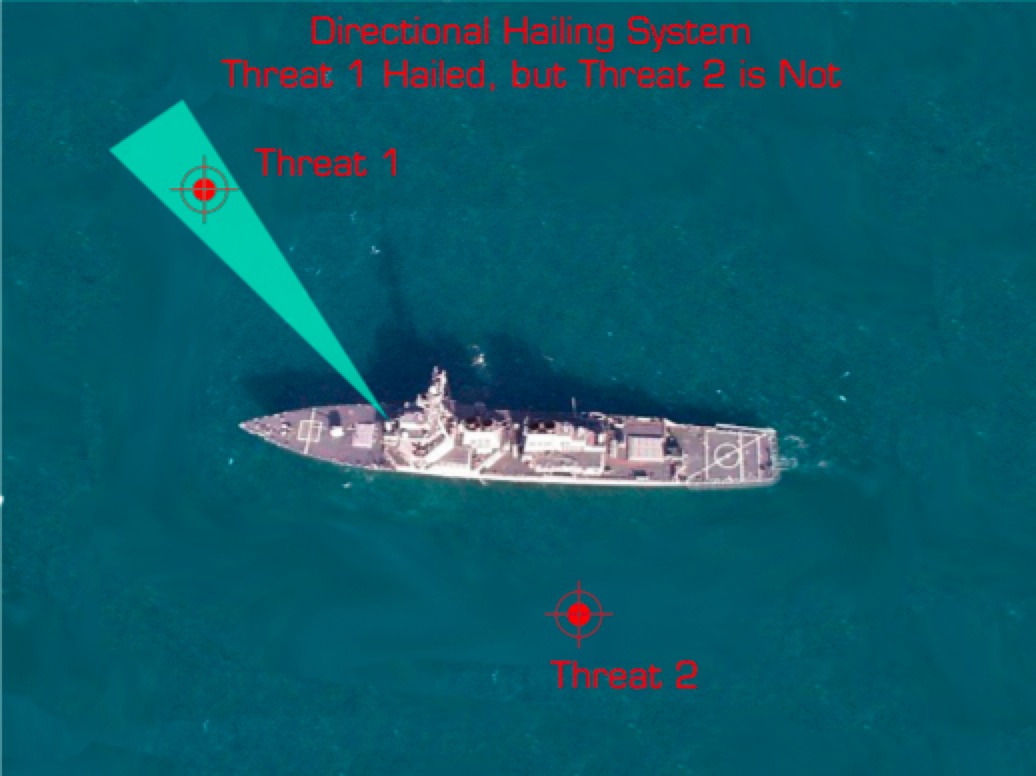 Target missed. |
The narrow beam width of a hyper-directional device means that it is difficult or impossible to address more than one acoustic target with the hyper-directional device simultaneously. While a hyper-directional device can be effective in addressing one target, multiple targets cannot be addressed. A multiple-target threat, such as a number of speedboats or jet-skis approaching a ship, or motorcycles approaching a tent city, is poorly met by the highly directional hyper-directional device. |
 Target Addressed! |
Technomad Solution: Technomad wide-dispersion military PA systems flood a large area with clear, articulate speech and sirens. Result: multiple targets can be addressed with confidence, without requiring any operator effort to aim or track multiple potential threats. |
Disadvantage #3: Different Volumes for Speech vs. Tones
The typical max SPL specifications of hyper-directional devices show a max continuous ‘tone’ SPL output of @ 145 dB, but max continuous ‘voice’ SPL outputs are generally 25 dB less (120 dB or lower). Further, most hyper-directional device designs have very poor frequency response and phase response, which significantly degrade speech clarity. The limited mid-band frequency response of hyper-directional devices is particularly destructive to male voices. Generally, hyper-directional devices are a poor fit to applications requiring live speech commands.
 |
Technomad Solution: Technomad full-range, high efficiency military PA systems offer high-efficiency output in both speech and siren frequency ranges, and does so WITHOUT high levels of phase shift, harmonic distortion, group delay, or other destructive audio artifacts. Male and female voices are delivered with outstanding clarity, and sirens and sound effects are accurate, detailed, and compelling. |
Disadvantage #4: Cost
Hyper-directional force protection systems are extremely costly – a recent price survey showed a typical system priced at $33,000. In contrast, a Technomad MilPA4 system – which covers a full 360-degree area, requires no aiming, and reproduces speech, music, and sirens accurately and without distortion – costs less than half of that price.
REFERENCE LINKS